Namhala: A Luxe Arabic Display Font for Handmade Creators
It started with a candle label—just one, sitting on my worktable next to a half-printed batch of lavender-scented soy candles. I’d been testing fonts all morning, but nothing felt *right*. Not too ornate, not too plain. Not stiff, not fussy. Then I opened Namhala—and everything softened. The curves flowed like ink brushed by hand, the spacing breathed, and the rhythm felt deeply intentional. That’s when I knew: this wasn’t just another Arabic font. It was a quiet, confident presence—elegant without shouting, decorative without distracting.
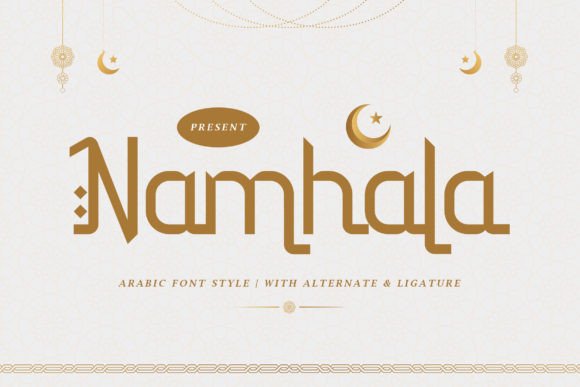
Namhala is a premium Arabic display font rooted in classical calligraphy traditions, yet refined for modern handmade use. Its letterforms carry subtle weight shifts, graceful terminals, and delicate internal detailing—think soft swellings at stroke beginnings, tapered finials, and harmonious baseline alignment. It doesn’t try to mimic ancient manuscripts; instead, it distills their soul into something clean, legible, and commercially versatile. As a display font, Namhala shines brightest where impact matters most: on product tags, greeting card headers, wedding welcome boards, boutique packaging, and printable wall art.
I used Namhala first on a set of olive oil bottle labels for a local farmer’s market pop-up. The font wrapped beautifully around the curved label surface—no distortion, no awkward kerning gaps. Because Namhala’s design prioritizes visual balance over rigid geometry, it holds up even when scaled down to 14pt on a 2” x 1.5” sticker. For larger applications—like a linen-wrapped wedding invitation suite or a framed planner cover—I leaned into its expressive alternates and optional swashes. A single word like “Ahlan” (Welcome) became a focal point, its letters connecting with gentle ligatures that felt both intentional and organic.
What makes Namhala especially useful for makers is how thoughtfully it bridges tradition and practicality. It’s not built for long paragraphs—that’s not its role—but it excels at short, meaningful phrases: “Bless This Home,” “Eid Mubarak,” “With Love,” “Est. 2023.” I’ve used it on ceramic mug decals (tested at 300dpi print resolution), cotton tote bag transfers (paired with a light gray sans serif for body text), and even laser-cut wooden signs for a Ramadan bazaar booth. Each time, customers paused—not just to read, but to *feel* the texture of the type.
Readability matters, especially when cutting with Cricut or Silhouette machines. Namhala includes clean vector outlines and well-spaced glyphs, so no hidden overlaps or stray nodes trip up your cut file. I tested it on a sticker sheet of mini Eid tags (¾” tall)—every character cut cleanly, even the delicate dots and diacritics. Just remember: avoid ultra-thin weights for sub-10pt applications, and always preview your design at actual size before printing or cutting. On physical products, Namhala performs best at 12pt and up for labels, 18pt+ for cards and tags, and 24pt+ for signage or wall art.
Font pairing is where Namhala truly sings. I almost always pair it with a warm, neutral sans serif—think Montserrat Light or Poppins Regular—for body copy, pricing, or ingredient lists. The contrast feels grounded and intentional: Namhala brings cultural warmth and artistry; the sans serif offers clarity and calm. For wedding stationery, I’ve layered it with a restrained serif like Playfair Display for names and dates—elegant but never competing. And yes, you *can* pair it with a delicate script for accents (like “&” or “x” in couple names), but keep those elements minimal. Namhala doesn’t need backup dancers—it’s the lead voice, clear and composed.
Before using Namhala in any commercial product—whether printed labels, SVG cut files, digital templates, or embroidered patches—check what’s included. Most Namhala licenses offer OpenType features: stylistic alternates, contextual ligatures, and multilingual support for Arabic, Persian, and Urdu. File formats typically include OTF and WOFF, compatible with Canva, Adobe Creative Cloud, Cricut Design Space, and Silhouette Studio. Crucially, verify the license permits commercial use—especially if you’re selling editable Canva templates, printable planners, or SVG bundles. Some versions include extended licensing for merchandise or unlimited digital distribution; others are limited to personal or small-batch use. A quick glance at the license terms saves real headaches later.
In my shop, Namhala has quietly elevated how people experience my products—not through flash, but through resonance. A birthday card with “عيد ميلاد سعيد” in Namhala feels more personal than generic Arabic fonts. A set of planner dividers titled “الهدوء” (Calm) and “النوايا” (Intentions) invites slower, more mindful use. Even my holiday gift tags—tiny rectangles stamped with “شكرًا” (Thank You)—carry a hush of sincerity. That’s the power of thoughtful typography: it doesn’t just say something. It says it *with care*.
Whether you're designing for Etsy, local craft fairs, Instagram shop previews, or custom client orders, Namhala gives your work a distinctive voice—one rooted in heritage, shaped for today’s handmade economy. It works as well on a matte-finish tea towel as it does in a digital download bundle. It supports seasonal collections (Ramadan, Eid, weddings, Diwali collaborations) without feeling trend-chasing. And because it’s a display font, it reminds you—and your customers—that some words deserve to be seen, not just read.
If you’re choosing a new Arabic typeface for your creative business, ask yourself: Does it reflect the intention behind your making? Does it hold up across materials, sizes, and uses? Does it feel like an extension of your brand—not a decoration, but a quiet signature? For me, Namhala answered yes—to all three.